
That lump behind the knee. The tightness that makes it hard to fully bend or straighten the leg. The dull ache that gets worse after a long day on your feet.
A Baker's cyst is common and often uncomfortable, but the cyst itself is rarely the real problem. Understanding what's driving it is the key to fixing it for good.
What Is a Baker's Cyst?
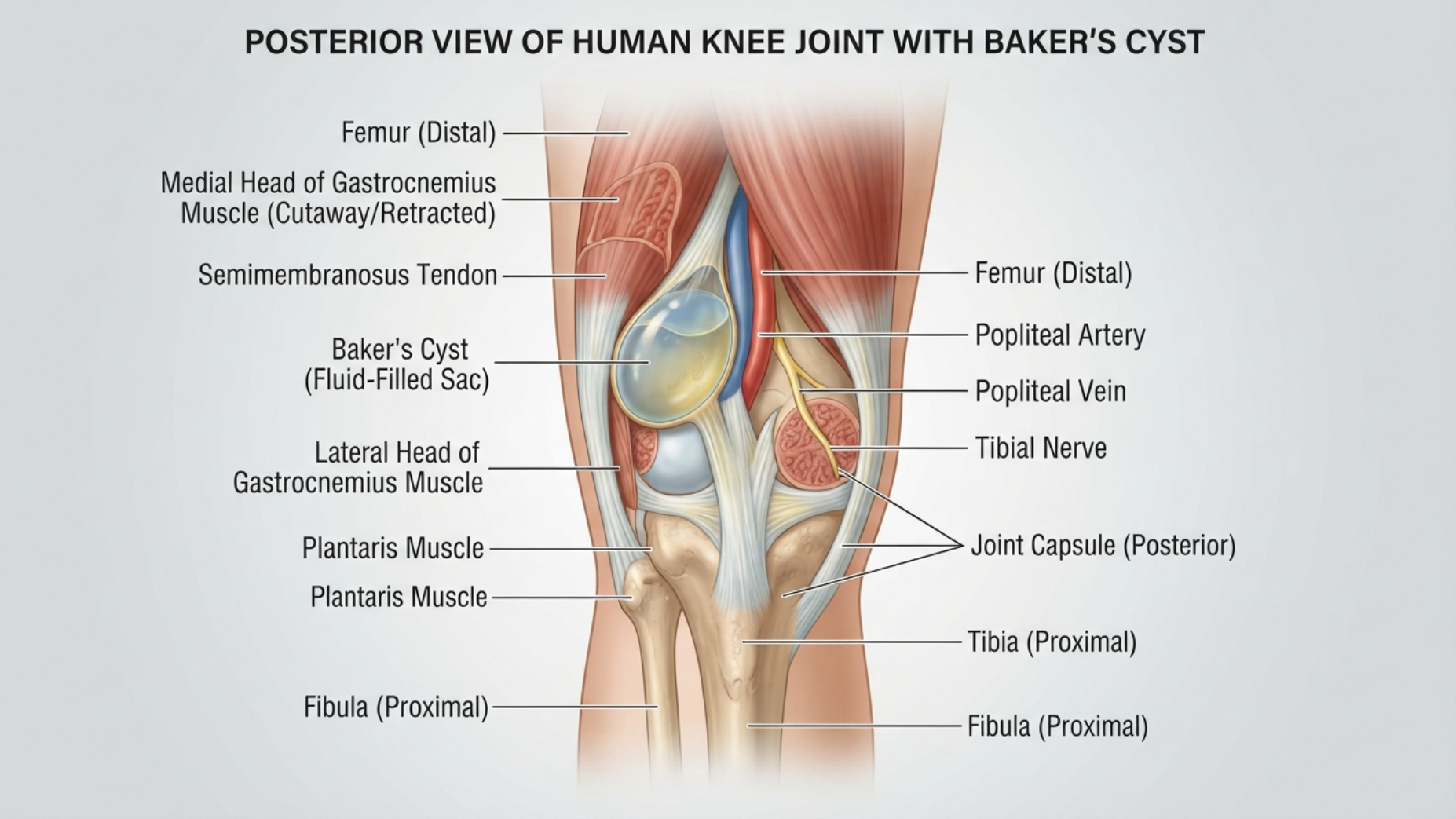
A Baker's cyst, also called a popliteal cyst, is a fluid-filled sac that forms at the back of the knee. It becomes enlarged when excess synovial fluid, the lubricating fluid inside the joint, accumulates and is pushed into a pocket of tissue behind the knee.
In most cases, the cyst is a sign rather than a condition in its own right. It almost always forms in response to an underlying problem inside the knee joint that's causing the joint to produce excess fluid. The usual causes are osteoarthritis, meniscus tears and general joint inflammation.
Baker's cysts are more common than many people expect. Research indicates they're present in approximately 10 to 41% of symptomatic knee patients, with prevalence increasing in older adults with degenerative joint conditions.
Baker's Cyst Symptoms: What Does It Feel Like?
Baker's cyst symptoms can range from barely noticeable to limiting, depending on the size of the cyst and the severity of the underlying issue.
The most common symptoms include:
A visible or palpable lump behind the knee
Tightness or pressure at the back of the knee, particularly when the joint is fully extended or bent
Aching pain that worsens with activity or prolonged standing
Stiffness that limits your range of motion
Swelling that extends into the upper calf in some cases
Symptoms tend to fluctuate. The cyst may feel smaller after rest and larger or tighter after activity, because movement drives more fluid into the joint and through to the cyst.
What Causes a Baker's Cyst?
Because a Baker's cyst is driven by excess joint fluid, the cause is essentially whatever is making the knee produce that fluid in the first place.
The most frequent underlying causes are:
Osteoarthritis: Degenerative changes in the joint cause inflammation and more fluid production. Baker's cysts are particularly prevalent in patients with knee osteoarthritis.
Meniscus tears: A damaged meniscus irritates the joint, prompting it to produce excess fluid. A meniscus tear and a Baker's cyst often present together.
Inflammatory arthritis: Conditions such as rheumatoid arthritis can cause marked joint inflammation and fluid build-up.
General synovitis: Inflammation of the joint lining with no specific structural cause can also lead to a cyst.
Treating the Baker's cyst without addressing the underlying joint problem is a common reason people find the cyst keeps coming back.
What is a Ruptured Baker's Cyst?
A ruptured Baker's cyst happens when the sac tears and the fluid leaks into the surrounding tissues of the calf. It can be quite uncomfortable when it happens.
A ruptured cyst tends to cause sudden, sharp pain behind the knee, swelling and bruising that spreads down into the calf, and a feeling that some people describe as warm water running down the leg.
These symptoms can also mimic a deep vein thrombosis (DVT). If you experience sudden calf swelling and pain, it's important to seek prompt medical assessment to rule out a clot before assuming it's a ruptured cyst. A ruptured Baker's cyst is not dangerous in itself, but a DVT is a more serious problem.
Most ruptured cysts settle on their own within one to four weeks with rest, elevation and anti-inflammatory medication.
Baker's Cyst Treatment Options
Treatment for a Baker's cyst depends entirely on what's causing it and how symptomatic it is.
Managing the underlying joint condition
This is the most important step.
If the cyst is linked to a meniscus tear, treating the tear, whether through meniscus repair or other knee arthroscopy surgery, often resolves the cyst without needing to treat it directly. Similarly, managing osteoarthritis effectively reduces fluid production and can shrink or eliminate the cyst over time.
Curious about meniscus tear recovery time? Our team can help.
Aspiration
The cyst can be drained with a needle under ultrasound guidance. This provides quick relief but doesn't address the source of excess fluid, so the cyst frequently returns if the underlying issue remains untreated.
Corticosteroid injection
An injection into the knee joint can reduce inflammation and fluid production, which in turn reduces the cyst. It's often used alongside aspiration and as part of managing an inflammatory condition like arthritis.
Physiotherapy
Strengthening the muscles around the knee and improving joint mechanics can reduce load on the joint and decrease fluid production over time. It's a core part of most conservative management plans.
Surgery
Direct surgical removal of a Baker's cyst is very rarely the first-line approach. If the cyst is causing significant symptoms and the underlying condition has been fully addressed, surgical excision may be considered.
For patients with severe arthritis that hasn't responded to other treatments, total knee replacement surgery can resolve both the arthritis and the associated cyst.
When to See a Knee Specialist About a Baker's Cyst
Most Baker's cysts don't require urgent attention, but there are situations where it's worth getting a proper assessment sooner rather than later.
See a knee surgery specialist in Melbourne if:
The lump is growing or causing significant pain
Your knee is swollen, stiff, or losing range of motion
You've had a sudden rupture with significant calf swelling
The cyst keeps returning after treatment
You have other knee symptoms that suggest an underlying structural problem, such as locking, catching or instability
Understanding when to worry about knee pain can help you decide whether your symptoms warrant a consultation sooner rather than later.
Living With a Baker's Cyst
For many people, a Baker's cyst is manageable in the short term. Avoiding high-impact activity, applying ice and taking anti-inflammatories can ease the swelling while you work out what's causing it.
The main point is that the cyst is a warning sign. It's telling you something is happening inside the knee that needs attention. Treating the signal without addressing the source is a short-term fix at best.
If you've been dealing with a Baker's cyst behind the knee that keeps coming back, or one that's limiting what you can do, it's worth finding out what's driving it. That's where a proper assessment from an orthopaedic specialist can help.
Get to the Bottom of What's Causing Your Baker's Cyst
A Baker's cyst that keeps coming back is more than just frustrating. It's usually a sign that something in the knee joint needs proper attention.
Dr David Sime is a fellowship-trained orthopaedic specialist surgeon in Melbourne with specialist expertise in knee conditions and surgery. He can identify what's driving your cyst and talk through your options, so you can get back to moving without that constant ache or tightness holding you back.
Book a consultation with Dr Sime's team today.
FAQs
What are the main symptoms of a Baker"s cyst?
The most common symptoms include a noticeable lump behind the knee, tightness or pressure at the back of the joint, aching pain that gets worse with activity, and stiffness when bending or straightening the leg. Some people have very mild symptoms; others find that the cyst significantly affects their day-to-day movement.
Does a Baker"s cyst go away on its own?
Small cysts in the absence of significant underlying joint disease can settle with rest and conservative management. But if an underlying condition like a meniscus tear or osteoarthritis is driving the excess fluid, the cyst is unlikely to resolve permanently until that cause is treated.
What happens if a Baker"s cyst ruptures?
A ruptured Baker"s cyst causes the fluid to leak into the calf, leading to sudden pain, swelling and sometimes bruising. These symptoms can look similar to a DVT, so prompt medical assessment is important. Most ruptured cysts resolve on their own within a few weeks with rest and anti-inflammatories.
How is a Baker"s cyst treated?
Treatment depends on the underlying cause. Options include aspiration (draining the cyst), corticosteroid injections, physiotherapy and treating the underlying joint condition surgically if needed. Draining the cyst alone without addressing the source almost always leads to recurrence.
Is surgery needed for a Baker"s cyst?
Most Baker"s cysts don't require direct surgical treatment. Surgery is typically only considered when the cyst is causing significant symptoms and the underlying joint condition has already been treated. Addressing the root cause, whether a meniscus tear or arthritis, often resolves the cyst without the need to remove it directly.